 YouTube
 Facebook
 Instagram
 TikTok
Mary McLeod Bethune
A School Begins With Five Girls
Five girls and a young boy: the beginning was small enough to count on two hands. In Daytona, Florida, in 1904, Mary McLeod Bethune opened a school with those six children. The boy was her son. Bethune was twenty-nine years old, and the institution that would carry her work into the future did not yet exist. What existed was a teacher, a handful of students, and a decision to begin before the resources matched the need.
It is easy to look backward from a university and see that first classroom as the inevitable opening of a success story. But nothing about its future was guaranteed. Five girls were not proof that a school could survive. A conviction was not a dependable income. Bethune had taken responsibility for something that would have to be sustained beyond its first hopeful day.
She was the daughter of formerly enslaved parents. Within her own family, the distance between slavery and freedom could be measured in a single generation. Yet freedom had not brought equal access to the institutions through which people built secure lives. In the segregated South, Black children grew up in a society that restricted their opportunities and then treated those restrictions as evidence of what they could become.
Education stood at the center of that injustice. A child could possess curiosity, discipline, and extraordinary ability without having a fair chance to develop any of them. Segregation shaped which doors opened, which resources were available, and whose ambitions received encouragement. For Black girls, racial exclusion and narrow expectations of women overlapped. Their futures were too often discussed in terms of the work others needed them to do, rather than the lives they might choose.
Bethune’s answer was a school.
That answer was practical, but it was also profound. To teach a child is to act on the belief that her mind deserves attention. To establish a school for girls denied equal opportunity is to give that belief a place to endure. Bethune was not waiting for the surrounding society to agree on the worth of her students. She began with their worth already settled.
The shortage of resources was real. It should not be softened into a charming detail about humble beginnings. Scarcity makes every commitment harder to keep. A school needs space, materials, and continuing support; its students need more than the enthusiasm of an opening day. Bethune had to build an institution while carrying out the work for which that institution existed. The children could not put their growing up on hold until conditions improved.
Her first consequential choice was to start at the scale available to her. Five girls did not amount to a solution for segregated education. They were, however, five actual children whose education mattered now. Beginning with them did not mean accepting a small future. It meant refusing to let the size of the injustice make the work immediately within reach seem worthless.
Her next challenge was continuity. An opening can be marked by a date; keeping a school alive demands a much longer kind of commitment. Bethune’s work had to become something families could depend on, something capable of welcoming more students and surviving the pressures placed upon it. Courage here was not only the willingness to attempt something difficult. It was the willingness to remain responsible for it.
The school grew. That simple statement holds the difference between a promise and an opportunity that lasts. More students could enter. A beginning made with very limited means developed into an educational institution with a future beyond its founding moment. Bethune’s commitment took a form that other people could join, support, and carry forward.
The school she founded became part of what is now Bethune-Cookman University. The distance between those first six children and a university is striking. But the importance of that growth is not only in the size of the institution. It is in the successive generations for whom education became available, and in the possibilities that could travel outward with them, beyond any single classroom.
Knowing that later history, we may be tempted to hurry past the beginning. The university seems like the destination that makes the story worth telling. Yet the first students were not merely a prelude to something more important. Their learning was already a reason to act. Bethune did not need to know the full reach of her work for those children to deserve it.
In 1904, there was no guarantee that her school would become an enduring institution. There were five girls, her young son, and a teacher prepared to make a beginning under conditions she had not chosen. The future would require far more work than that first step. Still, the door was open. For the children who entered, opportunity was no longer only something to hope for. There was a school they could attend.
Beyond the story
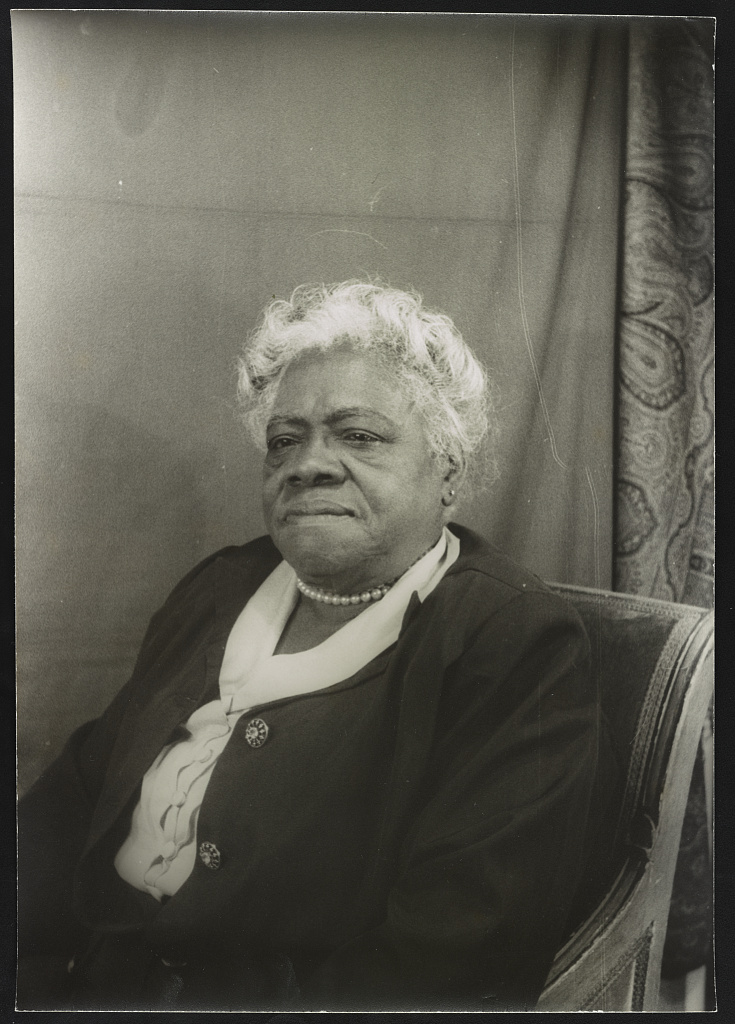
Mary McLeod Bethune
Explore the historical record behind this story.
Image credit: Carl Van Vechten / Library of Congress
Image source record · Public domain — rights / licence
Library of Congress: Van Vechten collection has no known copyright restrictions; collection restrictions expired in 1986.
Displayed at reduced size; no additional crop, colorization or retouching by Big Time Motivation.